
SEO, Google Ads & Social Media Marketing Services in Mumbai.
Introduction : How SEO, Google Ads, and Social Media Marketing Work Together
Today, customers often search online before choosing a product, service, or company. They compare websites, read reviews, explore social media pages, and look for businesses that understand their needs. This makes digital marketing an important part of building a successful business. Digital marketing Agency offers expert SEO, Google Ads, and social media marketing services in Mumbai to help businesses increase online visibility, attract potential customers, and achieve sustainable growth.
Whether you run a local shop, educational institute, real estate company, restaurant, professional service, or online store, having a strong digital presence can help you connect with potential customers. However, simply creating a website or posting on social media is not enough. You need a clear strategy that helps people discover your business, understand your services, and take action.
This is where a digital marketing agency in Mumbai can support businesses through search engine optimisation (SEO), Google Ads, social media marketing, Meta Ads, website development, and content marketing.
Each service has a different purpose. SEO helps improve organic visibility, Google Ads can reach people actively searching for specific services, and social media marketing helps businesses build relationships with their audiences. When these channels work together, they can support awareness, lead generation, and sales.
In this guide, we will explore the major SEO, Google Ads & Social Media Marketing Services, explain how they work, and discuss how businesses can choose the right strategy for their goals.
1. What Is Digital Marketing?
Digital marketing is the promotion of products, services, or brands through online channels. These channels include search engines, websites, social media platforms, email, online advertising, and other digital platforms.
Unlike traditional marketing methods that mainly use newspapers, television, outdoor advertising, or printed materials, digital marketing gives businesses opportunities to reach specific audiences and measure many campaign activities.
For example, a coaching institute in Mumbai may use SEO to appear in relevant search results, Google Ads to attract enquiries for upcoming batches, and Instagram to share student activities and course information.
Similarly, a local service provider may use a well-designed website, location-based SEO, and targeted advertising to attract customers in selected neighbourhoods.
The most suitable strategy depends on the business model, audience, competition, available budget, and desired results.
Why is digital marketing important?
Digital marketing can help businesses:
- Generate relevant website visits and enquirie.
- Communicate with customers through social platforms.
- Promote new products, services, offers, and events.
- Measure campaign performance using available analytics.
- Understand customer behaviour and improve marketing decisions.
Digital marketing is not a guaranteed shortcut to success. Results depend on the quality of the strategy, the offer, the website experience, the audience, and consistent optimisation.
2. Search Engine Optimisation (SEO)
Search engine optimisation, commonly called SEO, is the process of improving a website so that search engines can understand its content and users can discover relevant pages through organic search results.
When someone searches for a service such as “digital marketing agency in Mumbai,” search engines try to present useful and relevant results. SEO helps businesses make their websites clearer, more accessible, and more relevant to the searches they want to attract.
Google’s SEO Starter Guide explains that SEO helps search engines understand website content and helps people find websites through search.
Types of SEO
On-page SEO
On-page SEO focuses on improving the content and elements of individual website pages. It includes writing useful page titles, creating descriptive headings, improving meta descriptions, organising content, using relevant keywords naturally, and linking related pages together.
For example, a web development company could create a dedicated page explaining its website development services, the types of websites it builds, its process, and how customers can request a quotation.
Technical SEO
Technical SEO focuses on how effectively search engines can access, crawl, and understand a website. Important areas include website security, mobile usability, page indexing, site structure, XML sitemaps, redirects, and performance.
A technically sound website makes it easier for visitors to navigate and helps search engines discover important pages.
Off-page SEO
Off-page SEO includes activities that help establish a website’s reputation beyond its own pages. Relevant backlinks, genuine brand mentions, partnerships, and useful digital public relations can contribute to a website’s overall authority and visibility.
The focus should be on earning relevant, trustworthy references rather than buying spammy links.
Local SEO
Local SEO helps businesses become more visible to people searching for services in a particular location. It is especially useful for businesses that serve customers in specific cities or neighbourhoods.
A local business can improve its presence by maintaining accurate business information, building a complete Google Business Profile when eligible, collecting genuine customer reviews, and creating useful location-relevant website content.
For example, a company targeting customers in Andheri, Borivali, Goregaon, and Malad can create relevant service pages when it genuinely serves those areas. Each page should provide useful local information rather than simply repeating the same content with different locality names.
Benefits of SEO for businesses
SEO can support long-term organic visibility and help businesses attract people who are already researching relevant products or services. It may also improve website usability by encouraging clearer navigation, stronger content, and better page organisation.
However, SEO takes time, and rankings are never guaranteed. Results depend on competition, website quality, search demand, and many other factors.
A good SEO strategy focuses on sustainable improvement rather than promises of instant first-page rankings.
3. Google Ads: Reach Customers When They Search
Google Ads is an online advertising platform that allows businesses to promote products and services across eligible Google advertising channels.
Unlike SEO, which focuses on organic search visibility, paid advertising can help businesses gain visibility through campaigns once they are approved and eligible to serve. Businesses generally pay according to the bidding and charging model applicable to their campaigns.
Google Ads offers several campaign types. The right option depends on the marketing objective, audience, creative assets, and campaign setup. Businesses can review Google’s official campaign type guide to understand the available options.
Common Google Ads campaign types
Search campaigns
Search campaigns can display text ads when people search for relevant terms. They are useful when customers are actively looking for a product or service.
For example, a business might target searches related to website development, digital marketing services, or professional training courses in Mumbai.
Display campaigns
Display advertising can use visual advertisements to reach relevant audiences across supported websites and apps. It can support brand awareness and help businesses stay visible beyond search results.
Video campaigns
Video advertising can help businesses introduce a product, demonstrate a service, or share a brand message through eligible video placements, including YouTube.
Performance Max campaigns
Performance Max uses automation to help advertisers reach customers across eligible Google advertising inventory from a single campaign. It can be useful when the advertiser has suitable conversion goals, assets, and measurement in place.
The campaign type should be chosen according to the business objective, not simply because it is popular.
How to create a better Google Ads strategy
A successful campaign begins with a clear objective. Decide whether you want phone calls, form submissions, online purchases, appointments, or another measurable action.
Next, research the search terms your potential customers use. Build relevant ad groups, write clear advertisements, and send visitors to landing pages that match the promise made in the ad.
For example, if your advertisement promotes SEO services, visitors should land on a page explaining your SEO offering rather than a general homepage with no clear next step.
Track relevant performance indicators such as:
- Impressions and clicks.
- Click-through rate.
- Cost per click.
- Conversion rate.
- Cost per lead or acquisition.
- Qualified leads and actual sales.
A large number of clicks does not automatically mean a campaign is successful. The quality of the enquiries and the value they generate matter just as much.
Common Google Ads mistakes
Businesses can waste advertising budgets when they target overly broad keywords, send traffic to irrelevant pages, ignore search terms, fail to track conversions, or stop testing their advertisements.
Another common mistake is judging performance only by the number of leads. Some leads may be irrelevant, unreachable, or unlikely to become customers.
Reviewing lead quality and sales outcomes helps businesses make more informed decisions about future advertising budgets.
4. Social Media Marketing: Build Your Brand and Audience
Social media marketing involves using platforms such as Instagram, Facebook, LinkedIn, and YouTube to communicate with audiences, share useful content, build brand recognition, and encourage meaningful engagement.
Different platforms serve different purposes. Instagram may be useful for visual storytelling and short-form videos, LinkedIn can support professional communication and business-to-business marketing, and YouTube can provide space for tutorials, demonstrations, and educational content.
The best platform depends on where your target customers spend their time and what type of content helps them make decisions.
Important social media marketing activities
Content planning
A content calendar helps businesses plan posts around their services, customer questions, seasonal opportunities, and business goals.
A balanced calendar may include educational posts, service explanations, customer stories, behind-the-scenes content, frequently asked questions, and promotional messages.
Short-form videos and reels
Short videos can demonstrate products, answer common questions, explain a process, or introduce team members. The opening seconds should make the topic clear and give viewers a reason to continue watching.
Community engagement
Responding to relevant comments and messages can help businesses build relationships with potential customers. Timely, professional communication is particularly important when social platforms generate enquiries.
Brand consistency
Using consistent colours, typography, tone, and messaging helps people recognise the business across platforms. Consistency should not mean posting identical content everywhere; adapt the format to suit each platform.
Organic social media versus paid social media
Organic social media includes regular posts, stories, videos, and community interactions that are not paid advertisements.
Paid social media uses advertising budgets to reach selected audiences according to the platform’s targeting options and campaign settings.
Organic activity can help build an ongoing relationship with followers, while paid campaigns can help distribute specific messages to a wider or more targeted audience. Both approaches can complement each other.
Measure results using relevant indicators such as reach, engagement, video views, profile visits, website clicks, enquiries, and conversions. Choose metrics that match your objective instead of focusing only on follower numbers.
5. Meta Ads: Promote Your Business Through Facebook and Instagram
Meta Ads allows eligible advertisers to create campaigns across Meta’s advertising platforms, including Facebook and Instagram placements.
These campaigns can support objectives such as awareness, engagement, website traffic, leads, or sales, depending on the campaign setup and available features.
Meta Ads can be useful when a business wants to introduce a service to a relevant audience, promote an offer, generate enquiries, or reconnect with eligible audiences who have previously interacted with its online presence.
How to improve Meta Ads performance
Start by understanding your audience. Consider their needs, interests, location, and the problems your service solves. Use this information to develop relevant creative content and advertising messages.
Your advertisement should communicate one main benefit and include a clear next step, such as visiting a service page or submitting an enquiry.
Test different creative approaches, including images, videos, headlines, and calls to action. Review results regularly and use reliable conversion tracking where appropriate.
For example, a training institute might test a short course introduction video against a creative highlighting the curriculum and practical learning opportunities. The better option should be determined by meaningful performance data, not assumptions.
Avoid making unsupported claims or using misleading offers. Clear information helps attract people who understand what the business actually provides.
6. Website Development: Turn Visitors Into Customers
A website is often one of the first places potential customers visit to learn about a business. It should explain what the company does, who it serves, what makes its offering relevant, and how visitors can get in touch.
Website development is therefore an important part of digital marketing. Even a well-performing advertisement may generate poor results if it sends visitors to a confusing, slow, or unhelpful website.
What makes a business website effective?
A good business website should have:
7. Content Marketing: Give Customers a Reason to Trust You
- A clear explanation of the company’s products or services.
- Simple navigation and a logical page structure.
- Mobile-friendly layouts.
- Relevant service pages with useful information.
- Clear contact details and calls to action.
- Secure browsing through HTTPS.
- Readable content and accessible design.
- Appropriate analytics and conversion tracking.
Website performance should be evaluated in context. Technical improvements matter, but they need to work alongside relevant content and a useful customer experience.
For a service business, dedicated pages for SEO, Google Ads, social media marketing, and website development can help visitors understand each offering. These pages can also target different search intents without forcing every service into one overcrowded page.
Content marketing involves creating and sharing useful material to educate audiences, answer questions, explain services, and support customer decisions.
Examples include blog articles, guides, videos, case studies, infographics, email newsletters, and frequently asked questions.
Good content addresses real customer concerns. It should not exist only to insert keywords into a webpage.
For instance, a business offering digital marketing services could publish articles explaining how local SEO works, how to evaluate advertising performance, or how to prepare a website before launching a paid campaign.
How to create SEO-friendly content
Begin with audience research. Identify the questions people ask before purchasing your product or service. Review the search intent behind relevant keywords and decide what information the reader needs.
Organise the article with a descriptive title, a clear introduction, useful headings, short paragraphs, examples, and a practical conclusion. Include related terms naturally where they improve clarity.
Add internal links to relevant service pages and other helpful articles. Link to reliable external resources when they support a factual claim or help readers explore the topic further.
Use original examples and verify factual information before publishing. If AI tools assist with research or drafting, a human editor should review the final article for accuracy, usefulness, originality, and brand consistency.
Google recommends creating helpful, reliable, people-first content rather than content produced mainly to manipulate rankings. Read its guidance on creating helpful content.
8. SEO vs Google Ads vs Social Media Marketing
Each digital marketing channel has different strengths. Businesses should select a combination based on their objectives, resources, and customers.
| Marketing channel | Main purpose | Potential advantage | Important consideration |
| SEO | Organic search visibility | Supports long-term discoverability | Results take time and are not guaranteed |
| Google Ads | Paid visibility and demand capture | Can reach relevant searchers quickly once campaigns serve | Requires budget management and optimisation |
| Social media marketing | Engagement and brand building | Encourages ongoing communication with audiences | Needs relevant, consistent content |
| Meta Ads | Paid social promotion | Helps distribute campaigns to selected audiences | Creative quality and lead quality matter |
| Website development | Build a useful online destination | Supports customer experience and conversions | Needs maintenance and clear messaging |
| Content marketing | Educate and inform audiences | Builds understanding and supports search visibility | Quality and usefulness matter more than volume |
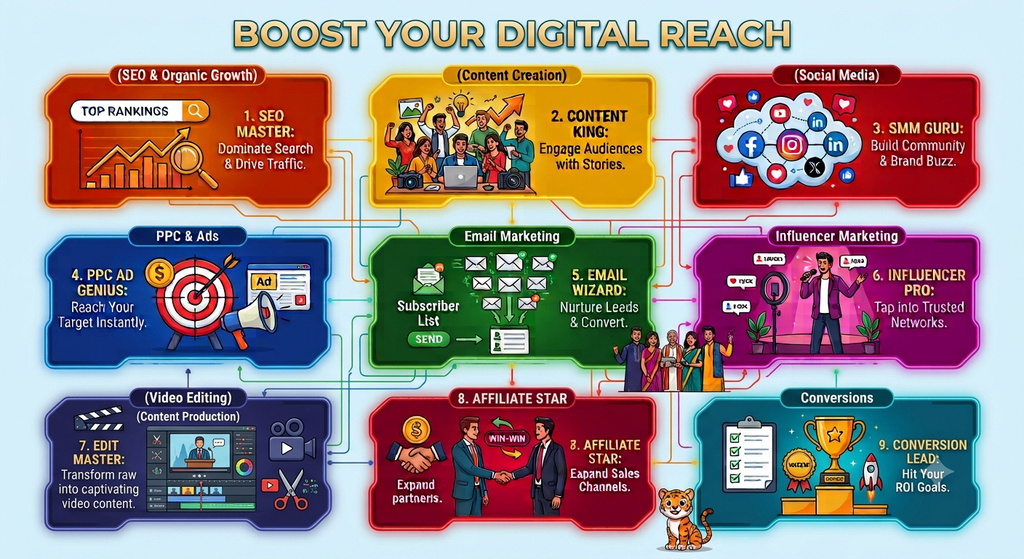
There is no universal winner. A business that needs enquiries quickly may test paid advertising, while a business investing in sustainable search visibility may prioritise SEO and content. A brand with a visually appealing product may benefit from social content and paid social campaigns.
A combined strategy can create more opportunities for customers to discover, evaluate, and contact a business.
9. How to Choose a Digital Marketing Agency in Mumbai
Choosing a digital marketing partner requires more than comparing prices. Businesses should understand what the agency will do, how performance will be measured, and how communication will work.
Check the agency’s services and expertise
Look for a clear explanation of the services offered. If you need organic search visibility, ask about keyword research, technical SEO, content planning, and reporting. If you need paid campaigns, ask how the agency approaches targeting, conversion tracking, testing, and budget management.
An agency should be able to explain its approach in language you understand.
Review examples and case studies
Ask for relevant examples of past work where available. Look for clear objectives, the actions taken, the time period, and measurable outcomes. Make sure any results are presented accurately and with appropriate context.
Past performance can provide useful information, but it does not guarantee the same results for every business.
Understand reporting and communication
A professional working relationship should include agreed deliverables, realistic timelines, access to relevant accounts, and regular updates.
Reports should explain what happened, what the results mean, and what the team recommends doing next. A
report filled with clicks and impressions may be incomplete if it does not connect those figures to business goals.
No agency can responsibly guarantee a particular Google ranking or a fixed number of sales without understanding the business and its circumstances.
Ask how success will be measured, what assumptions underpin the proposed strategy, and how the team will respond if results are below expectations.
For businesses searching for a digital marketing agency in Mumbai, location may help with communication and knowledge of local markets. However, service quality, transparency, relevant experience, and strategic fit should remain central to the decision.
10. A Practical Digital Marketing Example for a Mumbai Business
Consider a hypothetical coaching institute in Mumbai that wants to increase enquiries for an upcoming course.
First, the institute improves its website by creating a detailed course page. The page explains the curriculum, eligibility, learning format, schedule, and enquiry process. It is designed to work well on mobile devices.
Next, SEO activities help the website address relevant searches through useful content, clear page titles, appropriate headings, and a sound technical structure.
The institute can also test Google Ads for relevant searches when it needs to reach people actively looking for a course. The advertisements lead to the specific course page, and conversion tracking measures meaningful actions such as completed enquiry forms.
Meanwhile, social media content answers common questions, introduces instructors, explains course benefits, and shares genuine student experiences where permission has been obtained. Meta Ads can be tested to distribute selected content or generate enquiries.
Finally, the institute reviews which enquiries are relevant, which channels contribute to admissions, and where prospective students leave the process.
This example shows why digital marketing works best as a connected system. Each channel contributes a different role, and business results help guide future decisions.
11. Common Digital Marketing Mistakes to Avoid
Using keywords unnaturally: Repeating the same phrase in every paragraph can make content difficult to read. Use keywords where they fit naturally and include related terms when they genuinely help explain the topic.
Expecting instant SEO results: Organic visibility usually requires ongoing work. Avoid judging a long-term SEO strategy only by its performance during the first few weeks.
Running ads without conversion tracking: Without reliable measurement, it can be difficult to determine whether campaigns are generating useful enquiries or sales.
Ignoring mobile users: Many people browse websites on mobile devices. Check that text is readable, forms are easy to complete, and important information is easy to find.
Posting without a strategy: Random social media posts may not support a clear business objective. Plan content around audienneeds, brand positioning, and desired actions.
Publishing unreviewed AI content: AI can help with outlines, brainstorming, and editing, but unchecked output may contain errors, generic statements, or unsupported claims. Review content carefully and add original insights.
Focusing on vanity metrics: Likes, impressions, and website visits can be useful, but they should be interpreted alongside enquiries, qualified leads, conversions, and revenue where measurable.
Ignoring the customer journey: Marketing does not end when someone clicks an advertisement. The landing page, response time, sales process, and follow-up communication all influence the final outcome.
12. How DGmark Agency Can Support Your Digital Growth
Businesses often need several digital marketing activities to work together rather than operating independently. DGmark Agency can present its services around a clear business objective: helping companies strengthen their online presence and create better opportunities to connect with customers.
Depending on the services available and the needs of each client, a digital marketing strategy may include:
- Website development: Build or improve websites that communicate services clearly and provide a useful visitor experience
- Content marketing: Produce informative articles and other resources that answer customer questions and support the brand’s online presence.
- Lead generation: Connect relevant traffic, useful landing pages, enquiry forms, and follow-up processes.
The appropriate combination depends on the business, its target audience, available budget, competition, and current online presence.
Before beginning a campaign, establish measurable goals and agree on how progress will be reported. A useful strategy should explain not only which activities will be performed, but also why they matter and how their contribution will be evaluated.
DGmark Agency should describe its actual services, experience, and results accurately on its website. Clear information helps potential clients understand whether the agency is the right fit for their needs.
| Andheri West 405, 4th Floor, Pratik, Ratan Nagar Apartment-B Wing, Bus Stop, Near, Apna Bazar Rd, opp. Dhake Colony, D.N.Nagar, Andheri West, Mumbai, Maharashtra 400053 081045 95960 | Goregaon West 1st Floor, Vinay Kumkum, 13/14, Topiwala Marg, near Lords Universal College, Kakaji Nagar, Jawahar Nagar, Goregaon West, Mumbai, Maharashtra 400104. 081045 95960 |
13. Frequently Asked Questions
What does a digital marketing agency in Mumbai do?
A digital marketing agency helps businesses plan and manage online marketing activities. Depending on its services, this may include SEO, Google Ads, social media marketing, Meta Ads, website development, content marketing, and performance reporting.
Which digital marketing service is best for a small business?
The best service depends on the business objective. Local SEO may help a service provider improve local visibility, while paid search advertising may help reach people actively searching for a service. Social media can support brand awareness and customer engagement. A practical strategy should prioritise the channels most relevant to the audience and budget.
How long does SEO take to show results?
SEO timelines vary according to competition, website condition, content quality, search demand, and the work being completed. Improvements may take time to become visible, and rankings cannot be guaranteed. Businesses should track progress using appropriate indicators rather than relying on a fixed timeline.
Is Google Ads better than SEO?
Neither is automatically better. Google Ads can provide paid visibility when campaigns are eligible to serve and the budget is available. SEO focuses on organic visibility and can support longer-term discovery. The right choice depends on the business’s goals, time horizon, and resources.
Why is social media marketing important?
Social media marketing helps businesses share information, communicate with audiences, demonstrate products or services, and build brand recognition. Its value should be evaluated through relevant engagement, enquiries, website visits, and business outcomes.
Can AI help with SEO content writing?
AI can support topic research, outlines, drafting, editing, and content organisation. However, content still needs fact-checking, original insight, clear authorship where appropriate, and human review. The priority should be usefulness and accuracy, not producing large amounts of generic text.
How much should a business spend on digital marketing?
There is no single budget that suits every business. Spending depends on objectives, competition, audience size, service costs, and expected customer value. Businesses should begin with a realistic plan, measure results, and adjust investment based on evidence.
How can I measure digital marketing success?
Useful measurements may include organic search visibility, relevant website traffic, advertising cost per lead, conversion rate, qualified enquiries, customer acquisition cost, and sales. Select metrics that connect marketing activity to the outcomes the business wants to achieve.
Conclusion
Digital marketing is most effective when businesses understand the role of each channel and connect their activities to clear goals. SEO helps people discover relevant website content through organic search. Google Ads can provide paid visibility for selected searches and audiences. Social media marketing supports communication and brand building, while Meta Ads, website development, and content marketing can strengthen the wider customer journey.
For businesses operating in Mumbai, the right strategy should reflect the local market, customer needs, competition, and available resources. Instead of trying every channel at once, begin with clear objectives, build a strong online foundation, and measure what matters.
If your business is looking to improve its online presence, explore the services offered by DGmark Agency and identify the approach that best matches your goals.
Ready to strengthen your digital presence? Connect with DGmark Agency to discuss your business objectives and explore a digital marketing strategy suited to your needs.
Contact Dgmark Agency :
India’s Most Trusted Digital Marketing Agency in Mumbai :
Address: 405, 4th Floor, Pratik, Ratan Nagar Apartment-B Wing, Bus Stop, Near, Apna Bazar Rd, opp. Dhake Colony, D.N.Nagar, Andheri West, Mumbai, Maharashtra 400053
Phone: 09594690570
Website: https://dgmarkagency.com/
Google Maps: Get Direction